
Does your yak sleep with its tail over its snout?

There are scenes with our dogs that seem intimate, sweet, and just ours. It's as if they were private and only belong to our dogs; only we have access to them. But sometimes, they are much bigger than we imagine. Sometimes they tell the story of a precious legacy.
One of them is when the Yakutian Laika curls up to sleep and pulls its own tail over its snout, as if it were covering itself with a scarf. It's so cute, it's photogenic, and for those who live with the breed, it's almost poetic. What we don't imagine is that this isn't just a "cute way of sleeping." It says a lot about the history and origin of this dog, surviving in a region with an extreme climate.
It's a cry for survival.
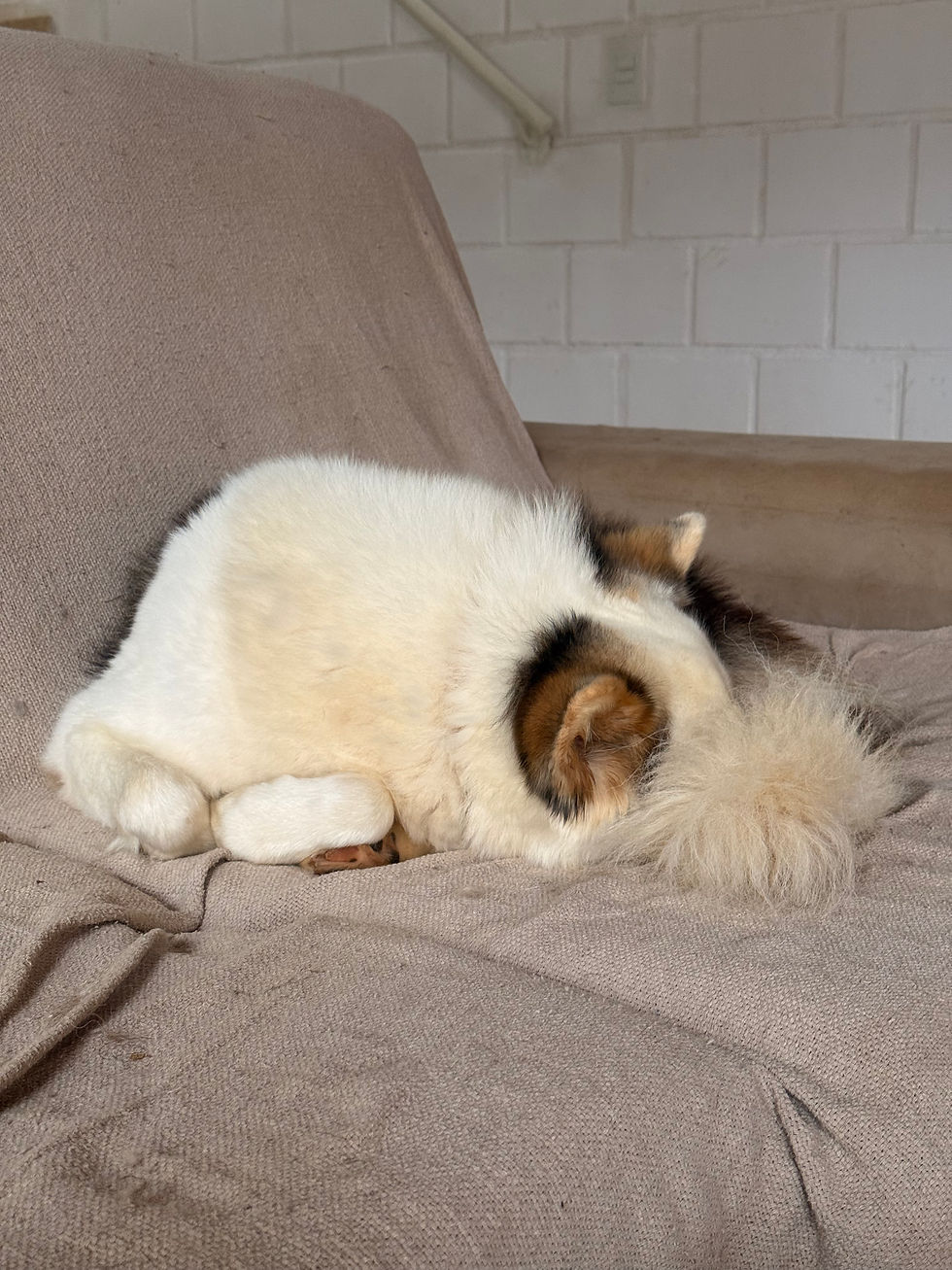
As is so often the case with primitive species, what today seems like just a charming detail was, in the past, an extremely intelligent solution for living in one of the harshest and most hostile environments on the planet. The scene is cute, but the logic behind it is anything but: it's thermal.
Among Nordic dogs and other canines from cold climates, the bushy tail serves not only for balance or body expression. At rest, it acts as extra protection. When a dog curls up into a ball (I affectionately call it the "donut position"), it reduces the body surface area exposed to the environment, and consequently decreases exposure to the cold. This, in itself, already helps to lose less heat. In the case of dogs adapted to the cold, there is an additional detail: the most vulnerable parts are protected in the center of this "thermal package".
In his famous work on the Arctic fox, Pal Prestrud explains that by curling up, the animal minimizes heat loss because the rounded shape offers the lowest surface area to volume ratio, and because the best-insulated parts are exposed while the most vulnerable are protected. He specifically describes the head being covered by the tail and torso while at rest, protecting the snout .
This matters because the snout is not just any area. A dog's nose is a highly specialized structure. A study published in Scientific Reports showed that the tip of the nose is a bare, moist, richly innervated, and normally cooler region with an important sensory role. In the study on the Arctic fox, the animal is described precisely as hiding its head in its tail and torso to minimize heat loss. In other studies, it is observed that when a dog sleeps curled up with the tip of its tail near its nose, it is usually trying to warm itself. Of course, the Yakutian Laika is not an Arctic fox. But both are canids adapted to severe cold, and the postural mechanism is consistent.
The Yakutian climate was unforgiving of improvisation. When we talk about the origin of the Yakutian Laika, we are talking about a region where cold, wind, ice, and long distances were part of daily life. For centuries, the breed accompanied the peoples of northeastern Russia in tasks such as hunting, transport, and guarding. The breed is the legacy of an original aboriginal people, developed in a harsh Arctic environment, where it retained many ancestral traits and a coat resistant to the climate.
In this context, small behaviors had great biological value. A dog that knew how to conserve heat, escape the wind, use snow as shelter, and protect its extremities had a real advantage. It wasn't a "quirk," it was efficiency. The tail functions almost like a portable blanket, and certainly contributed to the breed's survival.
The most beautiful part of this story is that it doesn't come from any theory invented by today's students. It also appears in historical accounts linked to primitive dogs (because the Yak isn't the only one that does this). A historical compilation, based on old Russian sources, cites an 1850 description by Professor Ivan Yakovlevich Gorlov stating that, in winter, the dogs of the region sought shelter in deep snow pits, "curling up and covering their muzzles with their furry tails."
This detail is precious because it shows two things at once: first, that the behavior is not a modern domestic fad; second, that it was already observed as part of the functional life of these dogs in their original environment since that time. In other words: the Yakutian Laika didn't start sleeping like that because it was spoiled in the comfort of our homes. It started, or rather, continued to sleep like that because it worked. It worked for at least several hundred years; here, science and history fit together very well.
So, when the Yakutian sleeps with its tail over its snout, the reasoning makes perfect sense: it's not "playing hard to get" to charm your heart; it's protecting an exposed, sensitive, and sparsely furred area from the wind and cold air, while conserving body heat. This habit didn't originate on your couch, but rather in the snow.
So every Yakutian who does this is cold?
Not necessarily.
This is the most interesting point: a behavior that originated as a survival strategy can continue to exist even outside the extreme situation that caused it. In other words, your Yakutian can do this:
because it's really cold,
because there is an air current,
because that position is comfortable,
Or simply because that ancestral bodily repertoire remains alive within him.
Primitive breeds are like that all the time: they carry in their bodies and behavior ancient solutions to ancient problems. What I like most about this behavior is that it summarizes the Yakutian Laika in an almost perfect way: it's a delicate behavior, but it was born from the harshness of a life in extreme conditions. It's cute, but above all it's functional.
When a Yakutian Laika sleeps with its tail over its muzzle, it's not just resting. It's repeating an ancient gesture and honoring its history. A gesture consistent with a breed created in the Arctic, which has withstood the climate. Historical accounts describe exactly this behavior in winter, and the science of thermoregulation in canines helps explain why. And perhaps that's one of the most fascinating things about the breed: many of the details that now delight on the sofa were honed long before, in the snow, at work, and out of the real need to survive.
Ultimately, that's what makes Yakutian so special. Even the way they sleep tells a story.
Study sources:
FCI. Yakutian Laika (FCI Standard No. 365) — ancient origin of the breed, historical use and adaptation to harsh arctic conditions.
ALKC / historical compilation of the breed — including the quote attributed to Ivan Yakovlevich Gorlov (1850) about dogs that, in winter, curled up and covered their muzzles with their tails.
Prestrud, P. (1991). Adaptations by the Arctic Fox (Alopex lagopus) to the Polar Winter. Arctic — curled posture, head covered by tail and reduced heat loss.
Bálint et al. (2020). Dogs can sense weak thermal radiation. Scientific Reports — canine rhinarium as a cold, bare, moist, and richly innervated structure.
Lund University, summary of the research above.
VCA Hospitals, popular clinical description of the "curl" position, associated with heat conservation.